Swarm robotics is no longer a concept limited to science fiction. Groups of small, autonomous robots are already being deployed in disaster zones, farms, and warehouses. But as these swarms grow in size and complexity, one critical question arises: how do you keep them secure, coordinated, and trustworthy without a central controller? Blockchain technology is emerging as a strong answer to that challenge.
What Are Swarm Robots and Why Do They Matter?
Swarm robots are collections of small, lightweight, self-operating machines that work together to complete tasks. Their design is inspired by nature — think of how ants build colonies, bees navigate to flowers, or birds fly in formation. Each robot in a swarm makes its own decisions, yet the group achieves complex goals together.
Key characteristics of swarm robots include:
- Decentralised decision-making — no single robot is in charge
- Collective behaviour — individual actions combine into group outcomes
- Scalability — more robots can be added without redesigning the system
- Redundancy — if one robot fails, others continue the mission
- Real-time collaboration — robots share data and adapt instantly
These qualities make swarm robots ideal for tasks like searching collapsed buildings, monitoring large agricultural fields, or managing inventory in warehouses — all without requiring constant human supervision.
The Security Problem Swarm Robots Face
Despite their potential, swarm robots come with serious coordination and security challenges. Since there is no central authority managing the group, several risks emerge:
- A hacked robot could send false instructions to the entire swarm
- Robots cannot easily verify whether shared data is genuine
- There is no transparent record of which robot completed which task
- Unauthorised devices could potentially infiltrate the swarm
These are not minor technical issues. In high-stakes environments like military operations or disaster rescue, a compromised swarm could cause serious harm. This is exactly where blockchain steps in.
How Blockchain Strengthens Swarm Robot Coordination
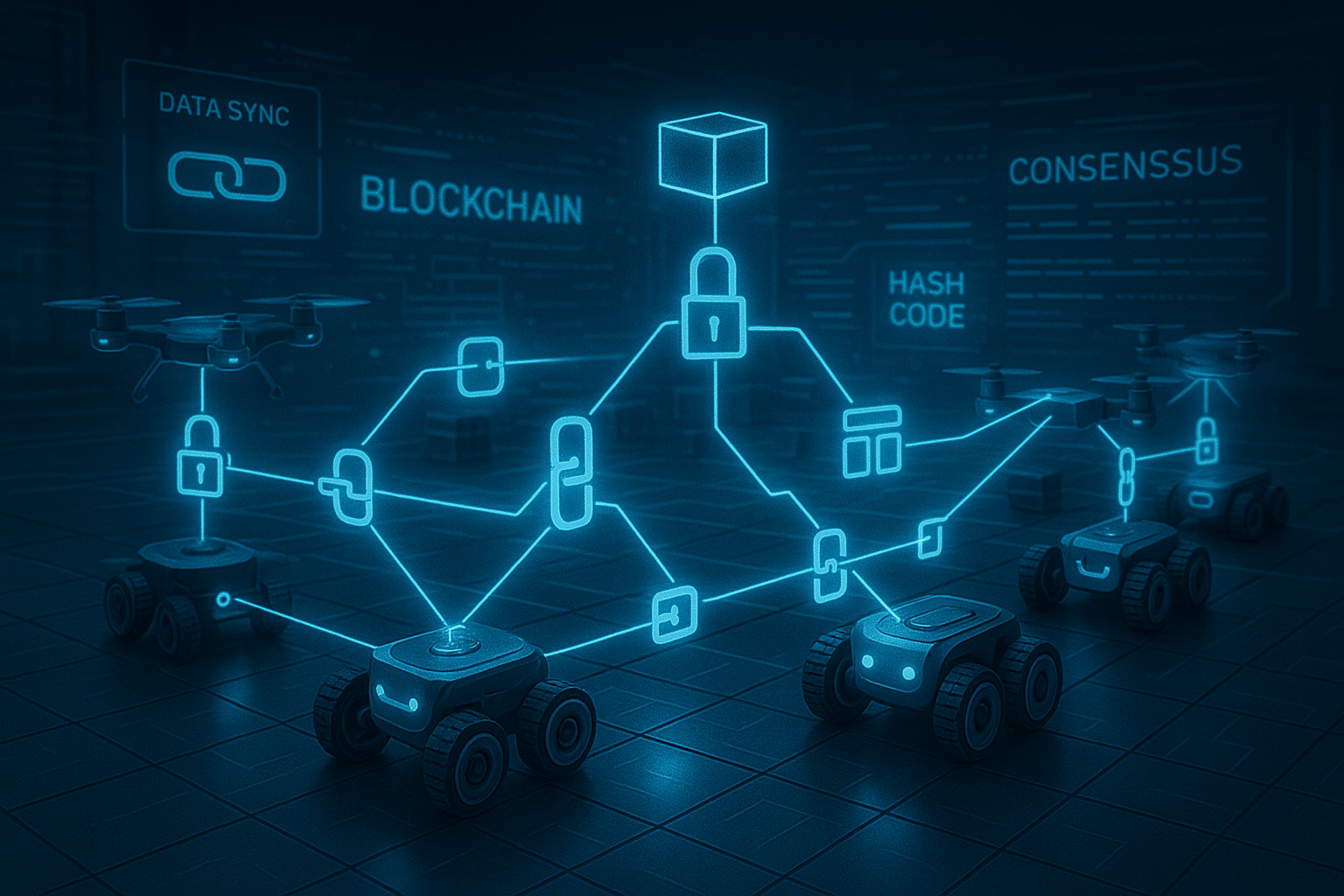
Blockchain provides a distributed, tamper-resistant ledger where every robot in the swarm can record and verify information without relying on a central server. Here is how each feature helps:
- Collective Decision-Making: Robots can propose and vote on tasks using smart contracts. Decisions are made by consensus, not by a single controlling unit.
- Encrypted Communication: Data exchanged between robots is cryptographically secured, preventing unauthorised robots from injecting false commands.
- Permanent Task Logs: Every action taken by every robot is recorded on the blockchain. This creates a full audit trail — what happened, who did it, and when.
- Digital Identity Verification: Each robot receives a unique blockchain-based identity, making it much harder for rogue devices to impersonate legitimate members of the swarm.
- Smart Contract Automation: Predefined conditions trigger automatic actions. For example, resources can be redistributed among robots once a specific task is confirmed complete.
| Blockchain Feature | Benefit for Swarm Robots |
|---|---|
| Distributed Ledger | No single point of failure or control |
| Smart Contracts | Automated task execution without human input |
| Cryptographic Identity | Prevents impersonation and infiltration |
| Immutable Records | Full audit trail of all robot actions |
| Consensus Mechanisms | Trustworthy group decision-making |
Real-World Applications Being Explored
Researchers and engineers are actively testing blockchain-powered swarm robotics across several industries:
- Disaster Response: Swarm drones can search collapsed buildings, securely log findings, and coordinate rescue efforts even when communication networks are unstable or unavailable.
- Military and Defence: Robot units can operate in hostile environments, verify orders through the blockchain, and reduce the risk of being misled by spoofed signals or enemy interference.
- Agriculture: Swarm robots can plant seeds, monitor soil conditions, and share crop health data with each other — all without human intervention and with a secure record of every action.
- Warehouse Automation: Collaborative robots, often called cobots, can use blockchain to manage inventory data in real time, ensuring accuracy and preventing data tampering across large fulfilment centres.
Challenges That Still Need to Be Solved
The combination of blockchain and swarm robotics is promising, but it is not without obstacles. Researchers are currently working through three major challenges:
- Scalability: As swarms grow larger, blockchain networks must handle a high volume of rapid transactions between robots without slowing down.
- Latency: Swarm coordination often requires split-second decisions. Current blockchain systems may introduce delays that are unacceptable in time-sensitive missions.
- Energy Consumption: Small robots run on limited power. Traditional blockchain consensus methods are computationally heavy, so new lightweight algorithms are being developed specifically for low-power robotic devices.
Despite these hurdles, the field is advancing steadily. Academic research, pilot programmes, and industry trials are all pushing this technology closer to practical deployment.
The merging of blockchain with swarm robotics represents a meaningful step toward autonomous systems that are not only capable but also secure and accountable. As lightweight consensus algorithms improve and blockchain networks become faster, the barriers to real-world adoption will continue to shrink. For industries that depend on large-scale automation — from agriculture to defence — this combination could redefine how machines work together without human oversight.
Frequently Asked Questions
Swarm robots are groups of small, autonomous machines that work together to complete tasks. Inspired by the collective behaviour of ants and bees, each robot makes independent decisions while contributing to a shared group goal. They operate without a central controller, making them scalable and resilient.
Blockchain provides a tamper-resistant shared ledger where robots can verify each other's identity, log actions permanently, and make collective decisions through smart contracts. This prevents hacking, data manipulation, and unauthorised robots from infiltrating the swarm.
The three main challenges are scalability, latency, and energy consumption. Blockchain networks must handle rapid communication between many robots, process decisions in real time, and run on lightweight algorithms suitable for small, low-power robotic devices. Researchers are actively developing solutions to all three problems.