Over 60 US tech companies signed a letter supporting open-weight AI models, while Anthropic’s CEO raised concerns over their cybersecurity risks.
More than 60 US technology companies have signed an open letter supporting American open-weight AI models, a move that notably excluded Anthropic. The letter arrived days after a Chinese AI model drew global attention, and it has since sparked a public disagreement over how open-weight systems affect cybersecurity and safety.
What the Open Letter Says
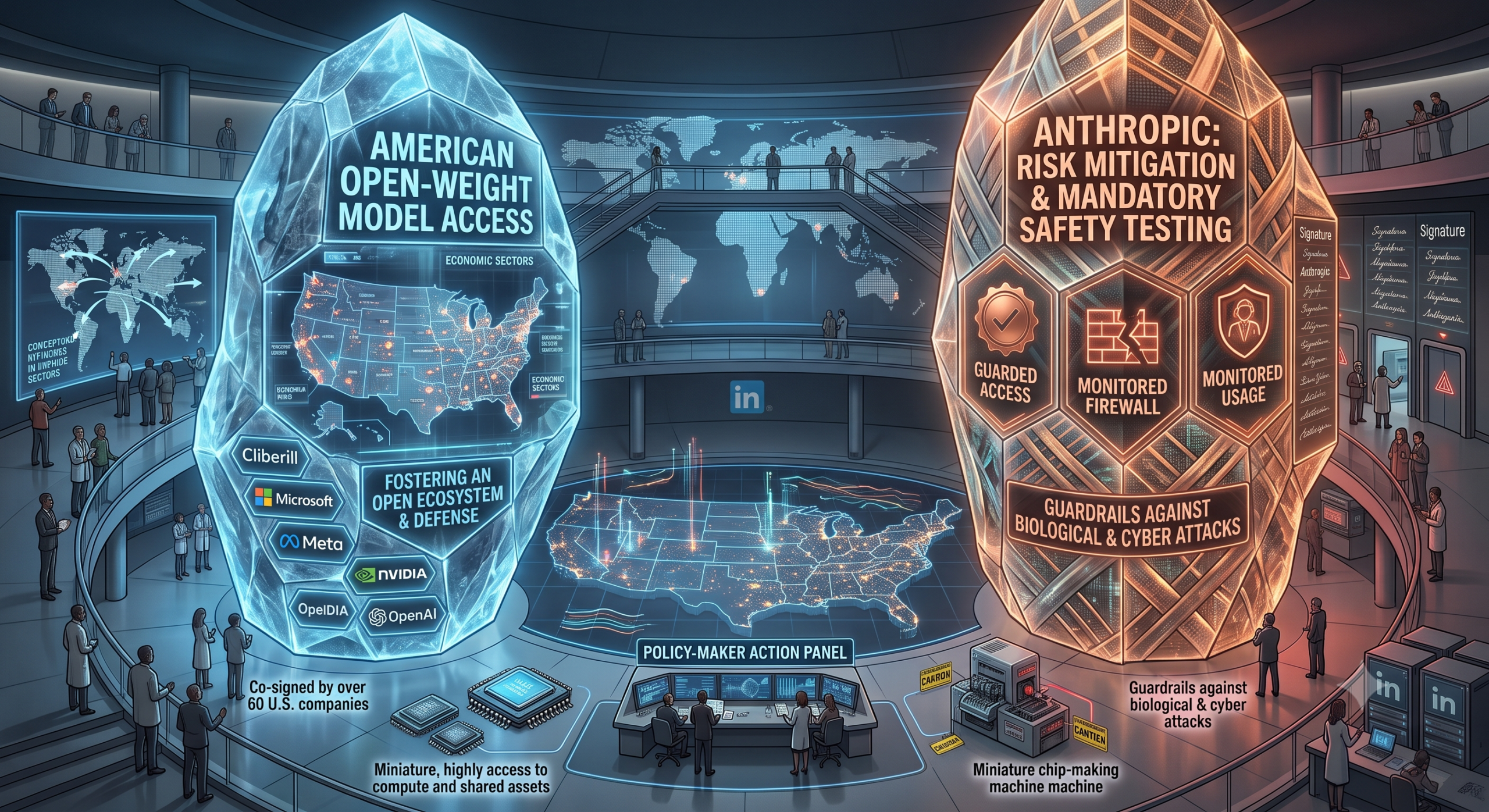
Dated July 24, the letter was co-signed by major companies including Microsoft, Nvidia, OpenAI, SpaceX, Google, IBM, Palantir, and Meta. It examined both the benefits and drawbacks of open-weight models compared to closed models, ultimately concluding that open-weight models would make advanced AI more accessible and adaptable for American users rather than locking them into specific providers.
The letter argued that US AI leadership should not be measured by a single frontier model, but by whether the country builds a broad, open ecosystem that spreads benefits across every sector. It called on policymakers to:
- Expand access to computing resources for startups and researchers
- Invest in shared training infrastructure and assets
- Avoid premature restrictions that could push innovation overseas
The letter also addressed cybersecurity directly, noting that while attackers have used advanced AI, open-weight models can support cyber defence work by improving transparency and helping detect vulnerabilities.
The Kimi K3 Backdrop
The letter followed close on the heels of Chinese lab Moonshot’s release of Kimi K3, a model the company described as the world’s first open model in the 3-trillion-parameter class, with 2.8 trillion parameters. Moonshot released the model’s full weights on July 27.
Kimi K3 is tagged as an open-weight model, which differs from a fully open-source model. Its release drew considerable enthusiasm from users, even as Anthropic accused Moonshot of distilling its own models to improve Kimi K3’s capabilities. The episode reignited debate over whether Chinese open-weight models could challenge the dominance of closed systems built by firms like OpenAI and Anthropic.
Anthropic’s Notable Absence
Anthropic, backed by Google and Amazon, was one of the most notable companies missing from the list of signatories. Amazon was also absent from the letter.
On July 27, Anthropic CEO Dario Amodei published a blog post clarifying the company’s position. He stressed that Anthropic has never called for banning open-weight models as a category, but said such models carry distinct risks.
“Open-weights models—it does not matter whether they come from China or anywhere else—do potentially present a higher risk than closed models,” Amodei wrote, explaining that it is difficult to apply guardrails to open-weight models or monitor their use once released, since the weights cannot be withdrawn afterward.
Where Amodei Agrees and Disagrees
Amodei’s blog post did not reject the broader letter outright. He agreed with much of its content but questioned whether open-weight models genuinely benefit defenders more than attackers, an issue the original letter had also touched on when acknowledging the risks of weights falling outside a developer’s control.
He specifically raised concerns about AI models developed by hostile states being used for cyberattacks or biological threats, including the potential weaponisation of pandemic-level viruses.
Instead of restricting open-weight models broadly, Amodei proposed three alternative priorities:
- Keeping powerful chips and chipmaking equipment out of the hands of authoritarian states
- Addressing industrial-scale distillation of AI models
- Requiring mandatory safety testing for all sufficiently capable models, whether open or closed
“To summarize my and Anthropic’s position, we have not and are not advocating for a ban on open-weights models as a category,” Amodei said, framing his stance as a call for targeted safeguards rather than blanket restrictions.
What This Debate Means Going Forward
The split between the letter’s signatories and Anthropic highlights a deeper disagreement within the AI industry over how to balance innovation, competitiveness, and security. Supporters of open-weight models argue that openness drives broader participation, faster innovation, and more thorough security testing through wider access. Critics, including Amodei, argue that once weights are public, there is no way to control how they are used or by whom.
This tension is likely to shape upcoming policy discussions in the United States, particularly around export controls on AI chips, safety testing requirements, and how the country positions itself against fast-moving international competitors in open-weight AI development.
Frequently Asked Questions
An open-weight model is one where the trained model's parameters, or weights, are made publicly available, allowing others to run and modify the model, though this differs from fully open-source models that also share training code and data.
Anthropic did not sign because CEO Dario Amodei believes open-weight models carry distinct cybersecurity and safety risks, since guardrails are hard to apply and released weights cannot be withdrawn.
Kimi K3 is an open-weight AI model released by Chinese lab Moonshot, described by the company as the first open model in the 3-trillion-parameter class, with 2.8 trillion parameters.