Machine learning is one of the most in-demand skills in the tech world today. But for beginners, the sheer number of algorithms can feel overwhelming. The good news is that you do not need a deep math background or years of coding experience to get started. Several algorithms are beginner-friendly, practical, and widely used across industries. Here is a clear breakdown of the seven best machine learning algorithms for beginners, explained in simple language.
What Is a Machine Learning Algorithm?
A machine learning algorithm is a set of rules that helps a computer learn from data and make decisions or predictions on its own. Instead of writing specific instructions for every possible situation, you feed data to the machine, and it figures out patterns by itself.
Think of it like teaching a child. You show them examples, and over time they learn to recognize things without you pointing them out every single time. Machine learning works the same way — the more quality data you provide, the better the model performs.
Supervised Learning Algorithms for Beginners
Supervised learning is where the machine learns from labeled data — meaning you already know the correct answers and use them to train the model. These are the most beginner-friendly algorithms in this category:
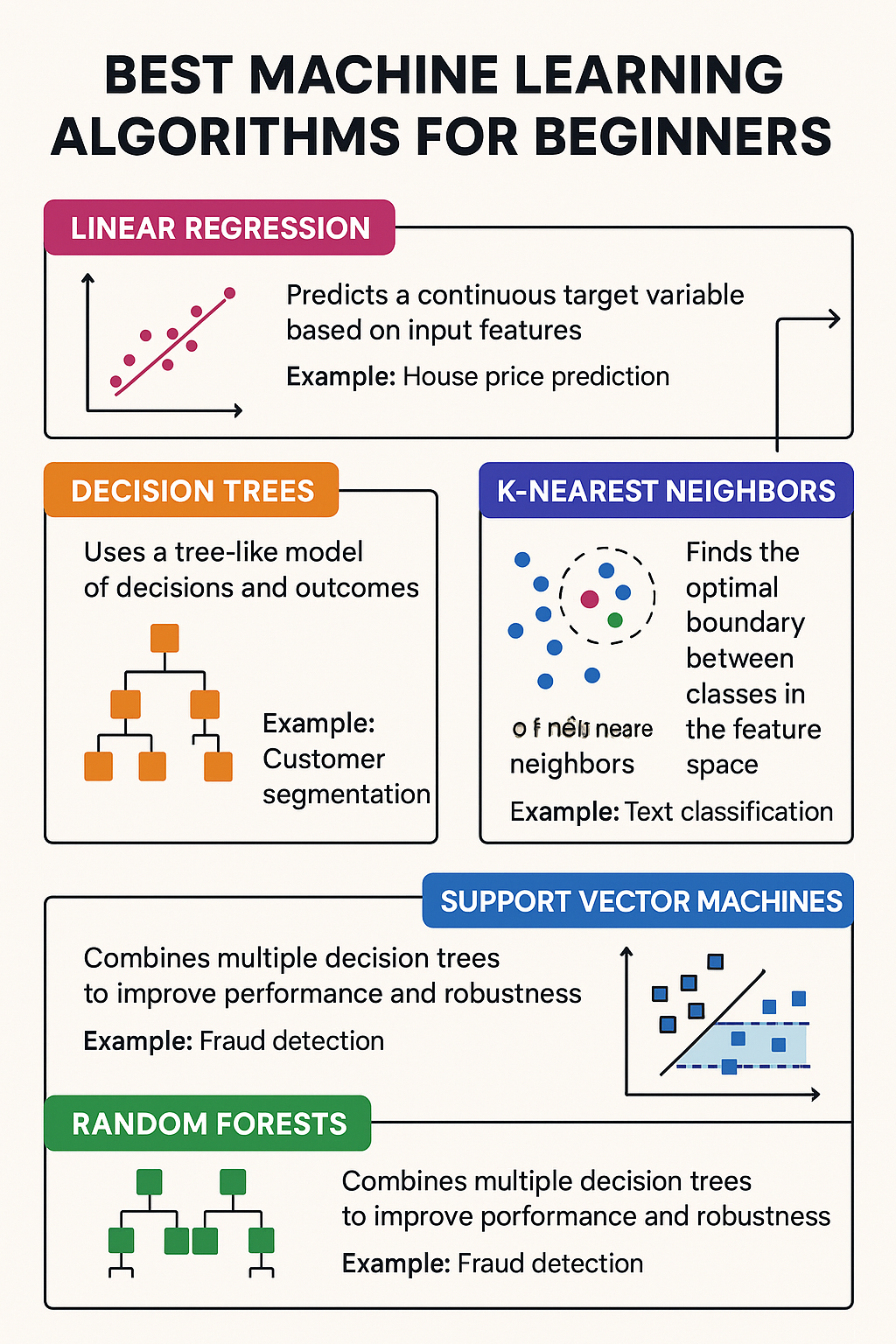
- Linear Regression — This is one of the simplest algorithms available. It predicts a numerical value based on input factors. For example, it can estimate a house price based on its size, location, and number of bedrooms. It works by fitting a straight line through the data, making it easy to visualize and understand. Best used for price estimation and sales forecasting.
- Logistic Regression — Despite the name, this algorithm is used for classification, not regression. It predicts binary outcomes — yes or no, spam or not spam, buy or not buy. It outputs results as probabilities, which makes it easy to interpret. Best used for spam detection and customer behavior prediction.
- Decision Trees — A decision tree splits data into branches based on conditions, similar to a flowchart. Each branch represents a decision, and the tree keeps splitting until it reaches a final answer. It is highly visual and easy to follow. Best used for loan approvals and medical diagnosis support.
- Naive Bayes — This algorithm uses probability to classify data. It is called “naive” because it assumes all input features are independent of each other, which is rarely true in real life but still works well in many cases. It is fast and performs well on text data. Best used for spam filtering and sentiment analysis.
- Support Vector Machine (SVM) — SVM finds the best boundary line or plane that separates different categories in your data. It works well when the groups are clearly separated. Best used for image classification and face detection.
Instance-Based and Unsupervised Algorithms
Not all machine learning requires labeled data. Some algorithms find patterns on their own, making them useful when you have raw, unlabeled datasets.
- K-Nearest Neighbors (KNN) — KNN classifies new data by comparing it to the closest existing data points. If most of your neighbors belong to a certain group, KNN assumes you belong there too. It requires no complex training phase — just comparison. Best used for recommendation systems and pattern recognition.
- K-Means Clustering — Unlike the others, K-Means does not need labeled data at all. It groups similar data points together automatically, like sorting items into buckets based on shared characteristics. Best used for customer segmentation and market research.
Quick Comparison of All 7 Algorithms
| Algorithm | Type | Best Used For | Beginner Friendliness |
|---|---|---|---|
| Linear Regression | Supervised | Price prediction, sales forecasting | Very High |
| Logistic Regression | Supervised | Spam detection, binary classification | Very High |
| Decision Trees | Supervised | Loan approvals, medical decisions | High |
| Naive Bayes | Supervised | Text classification, spam filtering | High |
| SVM | Supervised | Image sorting, face detection | Medium |
| KNN | Instance-Based | Recommendations, pattern spotting | High |
| K-Means Clustering | Unsupervised | Customer grouping, market research | High |
How to Choose the Right Algorithm as a Beginner
Picking the right algorithm depends on your data and your goal. Here are a few simple guidelines to help you decide:
- If you want to predict a number, start with Linear Regression.
- If you want to classify something as yes or no, try Logistic Regression or Naive Bayes.
- If you want a visual, easy-to-explain model, go with Decision Trees.
- If you have no labels in your data and want to find groups, use K-Means Clustering.
- If you want a simple comparison-based approach, KNN is a great starting point.
As a beginner, it helps to start with one algorithm, understand how it works, and then experiment with real datasets using tools like Python’s scikit-learn library. Practice is the fastest way to build confidence.
Each of these seven algorithms forms the foundation of machine learning. Mastering them gives you a strong base to move into more advanced topics like neural networks, ensemble methods, and deep learning. Start simple, stay consistent, and the complexity will become manageable over time.
Frequently Asked Questions
Linear Regression and Logistic Regression are considered the best starting points for beginners. They are simple to understand, easy to implement using tools like Python's scikit-learn, and widely used in real-world applications like price prediction and spam detection.
Basic math helps, but you do not need to be an expert to get started. Algorithms like Decision Trees and K-Nearest Neighbors are highly intuitive and can be understood without advanced mathematics. As you progress, learning basic statistics and linear algebra will help you go deeper.
In supervised learning, the model is trained on labeled data where the correct answers are already known — examples include Linear Regression and Decision Trees. In unsupervised learning, the model finds patterns in unlabeled data on its own — K-Means Clustering is a popular example of this type.