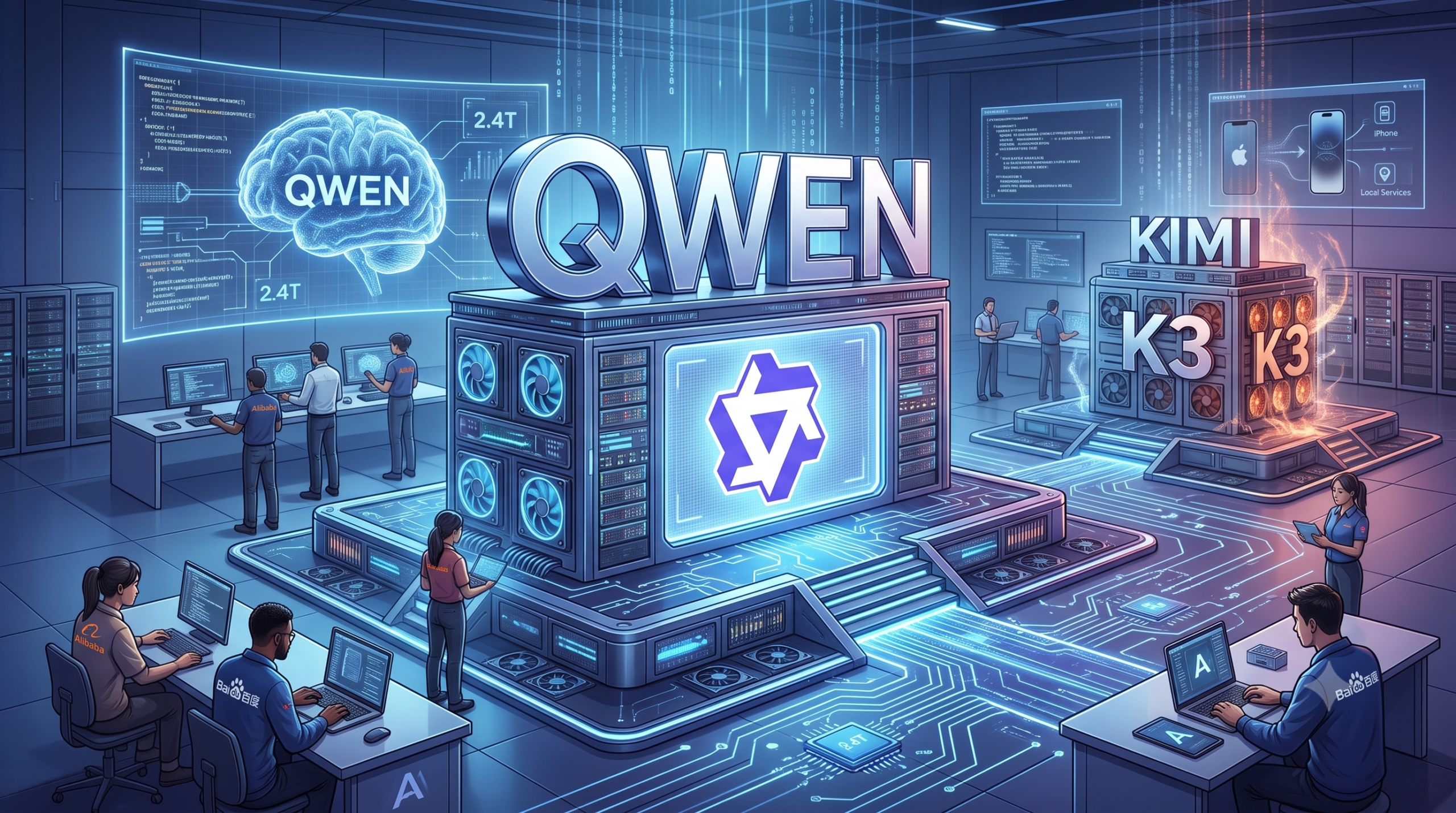
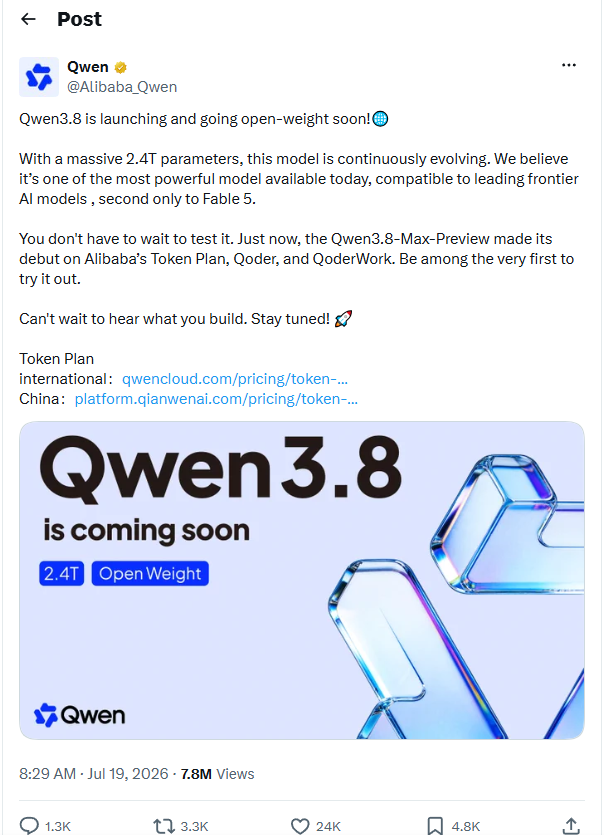
Alibaba has launched Qwen 3.8 Max in preview, a 2.4 trillion parameter model, just days after Moonshot AI’s Kimi K3, intensifying China’s AI competition.
Alibaba has introduced its newest flagship artificial intelligence model, Qwen 3.8 Max, in preview form, positioning it as one of the most capable large language models available today. The launch adds fresh momentum to an already fast-moving contest among Chinese technology firms racing to match leading AI developers in the United States.
What Alibaba Announced
Alibaba unveiled Qwen 3.8 Max on Sunday, July 19, describing the model as comparable to top-tier frontier AI systems, with the company placing it just behind Anthropic’s Claude Fable 5 in overall performance. The preview version is currently accessible to developers through Alibaba’s coding platforms, Qoder and QoderWork.
The company, headquartered in Hangzhou, said Qwen 3.8 Max carries 2.4 trillion parameters, a figure that reflects the scale of the model’s underlying architecture. Alibaba has not yet released further technical details, such as training data composition or benchmark scores, but confirmed that an open-weight version of the model will follow in the near future.
Why Open-Weight Models Matter
China’s approach to AI development has increasingly leaned toward releasing models with open weights, a strategy that stands apart from the more closed approach favoured by several US firms. Open-weight releases allow developers around the world to:
- Download the model’s weights directly
- Modify and fine-tune the model for specific use cases
- Deploy the model on their own servers or infrastructure
- Build new products and services on top of the base model
This approach has helped Chinese AI labs build wider developer adoption and international visibility, even as questions remain about monetisation and long-term sustainability compared with subscription-based or API-only models.
Kimi K3 and the Pressure From Moonshot AI
Qwen 3.8 Max arrives only days after Moonshot AI, another Chinese AI startup, released its own flagship model, Kimi K3. That model is said to rival leading offerings from both Anthropic and OpenAI, and it edges out Qwen 3.8 Max in scale with roughly 2.8 trillion parameters.
Moonshot AI said demand for Kimi K3 exceeded its expectations, placing significant strain on its available computing infrastructure. As a result, the startup, which is reportedly preparing for an eventual public listing, announced a temporary pause on new subscriptions to its AI chatbot platform so it can continue serving its existing user base without disruption.
A Wider Boost From Apple Intelligence
Alibaba’s Qwen models may also see broader adoption within China following a separate but related development. China’s internet regulator has approved the rollout of Apple Intelligence, Apple’s on-device generative AI feature, for iPhones registered for use in the country.
Rather than relying on Gemini or ChatGPT integrations as it does elsewhere, Apple Intelligence in China will draw on AI capabilities developed by Alibaba and Baidu, as part of a partnership with both local technology companies. This arrangement could give Qwen models a significant distribution advantage across one of the world’s largest smartphone markets.
What This Means for the Global AI Race
The near-simultaneous launches of Qwen 3.8 Max and Kimi K3 highlight how quickly the competitive landscape among Chinese AI developers is evolving. For users and developers, this rapid pace of releases means:
- More choice between open-weight and proprietary AI models
- Faster iteration cycles as companies compete for developer attention
- Increasing pressure on US-based AI labs to maintain their performance lead
- Greater integration of Chinese-developed AI into everyday consumer devices
As both Alibaba and Moonshot AI continue refining their models, the coming months are likely to bring further updates, expanded technical disclosures, and potentially new benchmark comparisons against US-built systems.
Conclusion
Alibaba’s Qwen 3.8 Max marks another step in China’s push to compete at the frontier of AI development, arriving alongside Moonshot AI’s Kimi K3 and a fresh Apple partnership that could widen its reach. With an open-weight release still to come, developers and businesses will be watching closely to see how these models perform once fuller technical details are made public.
Frequently Asked Questions
Qwen 3.8 Max is Alibaba's newest large language model, currently available in preview to developers through the company's coding platforms.
Kimi K3, developed by Moonshot AI, has a larger parameter count at roughly 2.8 trillion compared to Qwen 3.8 Max's 2.4 trillion, though both are positioned as top-tier models.
Alibaba has confirmed that an open-weight version of Qwen 3.8 Max will be released, though a specific date has not been announced.