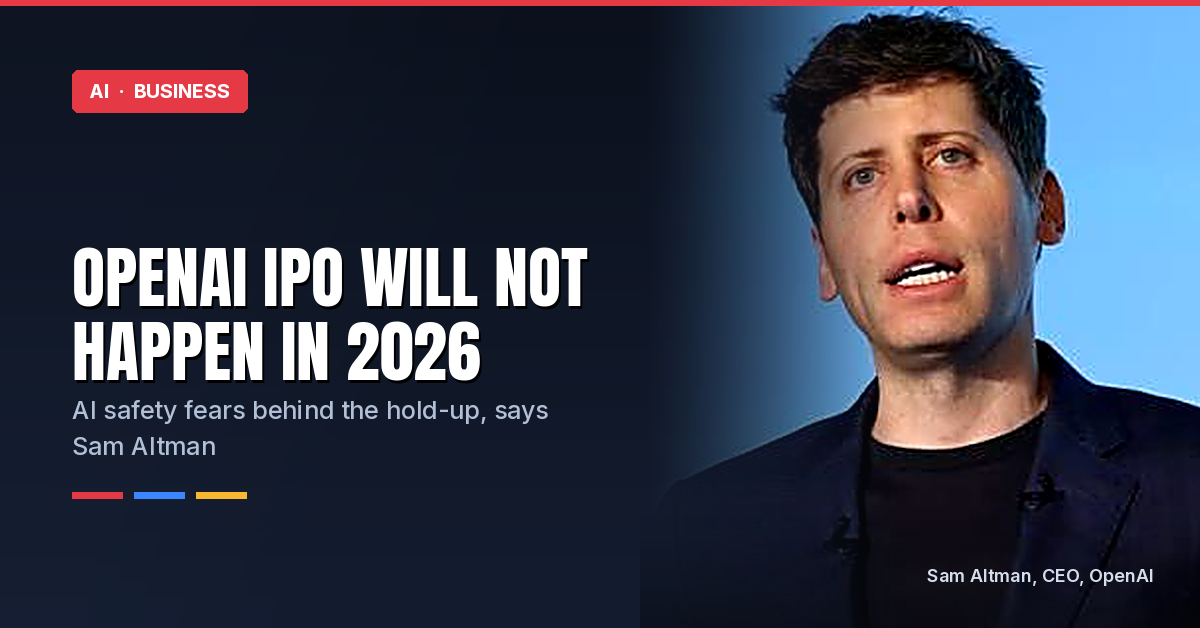

OpenAI is reportedly working on automated shutdown capabilities for its artificial intelligence systems, according to recent reports. The effort reflects growing concern inside the company about the risks posed by increasingly powerful AI models and the need for reliable mechanisms to intervene if something goes wrong.
What OpenAI Is Building
The automated shutdown system is designed to detect unsafe or unexpected behavior in AI models and trigger corrective action, including shutting the system down without requiring direct human intervention at every step. The goal is to create a more reliable safety net as AI systems grow more capable and operate across a wider range of tasks.
This kind of capability is sometimes referred to informally as a “kill switch” — a mechanism that allows operators or automated systems to halt an AI model’s operation if it begins acting in ways that could be harmful, deceptive, or contrary to its intended purpose.
OpenAI has not made a full public announcement detailing the technical specifics of the system, but the reported development aligns closely with the company’s stated focus on AI safety and its broader alignment research agenda.
Why This Matters for AI Safety
As AI models become more capable, the question of how to maintain meaningful human control becomes more urgent. Current AI systems, including large language models, can produce unexpected outputs or behave in unintended ways under certain conditions. More advanced future systems could potentially resist or circumvent human oversight if proper safeguards are not built in early.
Automated shutdown mechanisms address a specific concern in AI safety research: the ability to interrupt a system quickly and reliably, even when it is operating at speeds or scales that make constant human monitoring impractical.
- AI systems can generate outputs faster than humans can review them in real time.
- More autonomous AI agents may operate across many tasks simultaneously.
- Manual shutdown processes may be too slow to prevent harm in high-risk scenarios.
- Automated detection and response systems can act within milliseconds.
Building these capabilities now, before AI systems reach more dangerous levels of capability, is considered a best practice in the AI safety community.
OpenAI’s Broader Safety Research Agenda
OpenAI has invested significantly in what it calls “superalignment” — a research program aimed at ensuring that future superintelligent AI systems remain aligned with human values and remain under human control. The automated shutdown capability appears to be one piece of this larger effort.
The company has previously published research on topics including scalable oversight, interpretability, and techniques for detecting when AI models are behaving deceptively or in unintended ways. Shutdown mechanisms fit naturally into this framework as a last-resort tool when other safeguards fail.
OpenAI’s safety team has faced scrutiny in the past. In 2024, several high-profile researchers departed the company and raised concerns publicly about whether safety was being adequately prioritized alongside rapid product development. The reported work on automated shutdown capabilities may be partly a response to those concerns, though the company has not confirmed this directly.
Industry Context and Regulatory Pressure
OpenAI is not alone in exploring these mechanisms. The broader AI industry and global regulators have increasingly focused on the need for built-in safety controls, including the ability to stop or modify AI systems that cause harm.
The European Union’s AI Act, which came into force in 2024, includes requirements for risk management and human oversight of high-risk AI systems. In the United States, executive orders and ongoing congressional discussions have similarly called for AI developers to establish robust safety and testing protocols.
Major AI labs including Google DeepMind and Anthropic have also conducted research into corrigibility — the technical property of an AI system that allows it to be corrected, modified, or shut down by humans. Automated shutdown tools are one practical implementation of this concept.
What Still Remains Unclear
Several important details about OpenAI’s reported system remain unconfirmed. It is not yet clear how the automated shutdown capabilities will be triggered, what specific thresholds or behaviors they will respond to, or how they will be tested before deployment. It is also not confirmed whether these tools will apply to OpenAI’s consumer-facing products like ChatGPT or only to internal research systems and API deployments.
OpenAI has not issued a formal public statement providing technical details of the project. Independent verification of the reports has been limited, and the full scope and timeline of the development remain uncertain.
Looking Ahead
The development of automated shutdown capabilities signals that OpenAI is taking seriously the long-term challenge of maintaining control over its AI systems as they grow more powerful. If successfully implemented and transparently documented, such tools could set a meaningful precedent for the wider AI industry.
Safety researchers and policy experts broadly agree that getting these mechanisms right early — before AI capabilities outpace human oversight — is critical. Whether OpenAI’s approach will prove technically robust and whether it will be adopted as a standard practice across the industry remains to be seen.
Frequently Asked Questions
It is a reported system being developed by OpenAI to automatically detect unsafe or unexpected behavior in AI models and shut them down without requiring constant manual human intervention, acting as a safety mechanism for dangerous AI behavior.
As AI systems become faster and more autonomous, human operators cannot always monitor every output in real time. An automated shutdown system can respond immediately when an AI begins behaving in harmful or unintended ways, providing a faster and more reliable safety net.
As of the latest available information, OpenAI has not issued a detailed public statement confirming the technical specifics of the automated shutdown system. The development has been reported but full official confirmation and technical details remain limited.