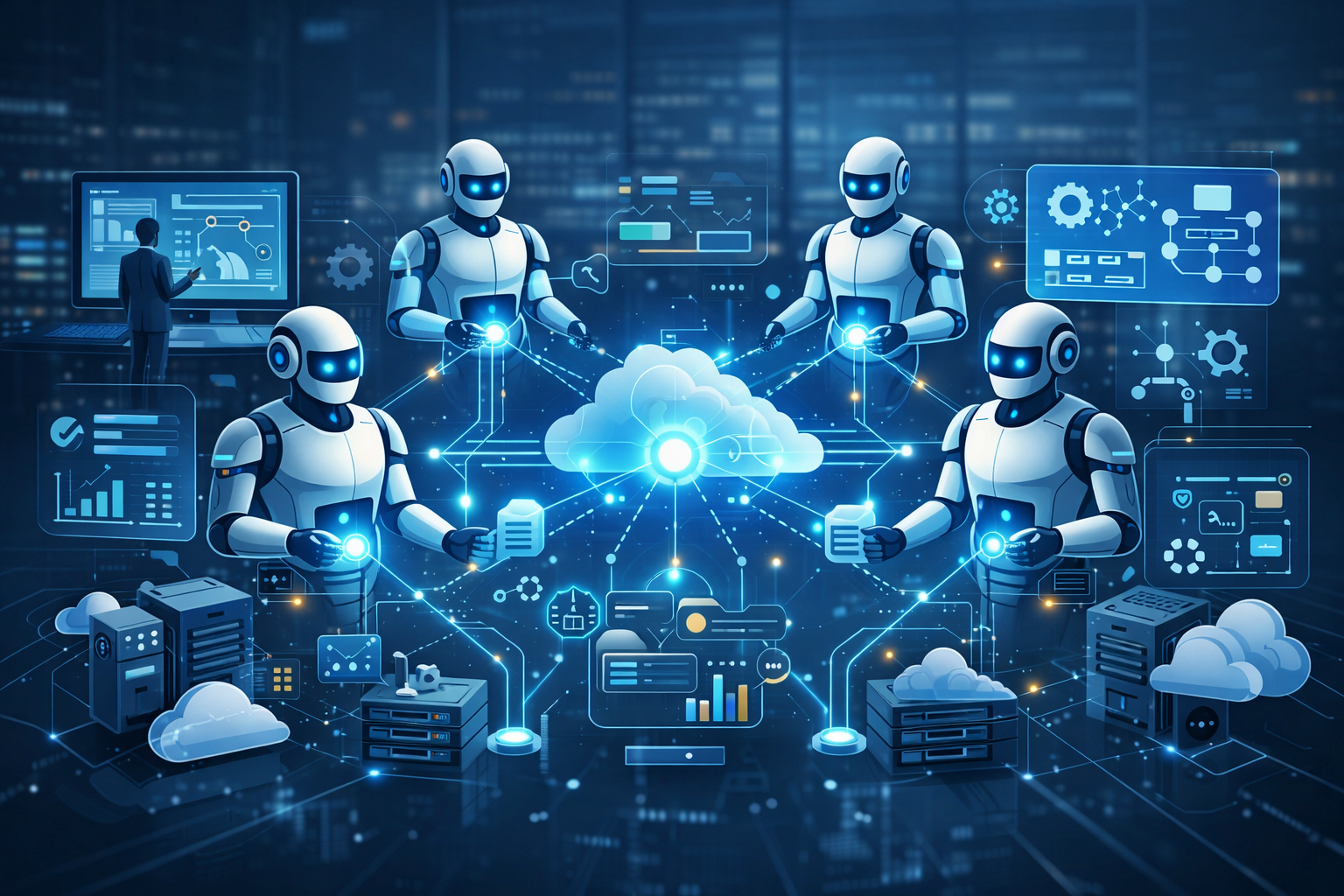
Automation is no longer just about following fixed rules. Multi-Agent AI is reshaping how businesses handle complex workflows by deploying multiple AI systems that work together as a coordinated team. Each agent plays a specific role, making the entire process faster, smarter, and far more adaptable than traditional automation methods.
What Is Multi-Agent AI?
Multi-Agent AI refers to a system where several independent AI agents communicate and collaborate to complete tasks. Rather than relying on a single AI to manage everything, each agent is assigned a specific responsibility.
For example, one agent may collect and monitor incoming data, another may analyze patterns within that data, and a third may take action based on the analysis. Together, they function like a digital workforce capable of handling tasks that would overwhelm a single AI system.
This approach mirrors how human teams operate — with specialists working in coordination toward a shared goal.
How Multi-Agent AI Improves Automated Workflows
In a traditional automated workflow, a single system processes tasks in a linear sequence. If one step fails or conditions change unexpectedly, the entire workflow can break down. Multi-Agent AI solves this problem by distributing work across multiple agents that operate simultaneously.
- Parallel processing: Multiple agents handle different steps at the same time, reducing overall processing time.
- Real-time adaptability: If conditions change mid-process, agents can adjust their actions without waiting for human intervention.
- Fault tolerance: If one agent encounters an error, others continue working, preventing complete workflow failure.
- Continuous learning: Agents can optimize how they perform tasks over time based on outcomes and feedback.
This makes automated workflows not just faster, but genuinely more reliable and intelligent.
Key Benefits of Multi-Agent AI Systems for Businesses
Organizations across industries are adopting Multi-Agent AI because of the clear operational advantages it offers. Here is a quick comparison of traditional automation versus Multi-Agent AI:
| Feature | Traditional Automation | Multi-Agent AI |
|---|---|---|
| Flexibility | Fixed rules only | Adapts to changing conditions |
| Scalability | Difficult to scale | New agents added easily |
| Fault Tolerance | Single point of failure | Other agents continue if one fails |
| Decision Making | Pre-programmed responses | Real-time intelligent decisions |
| Human Supervision | Frequent oversight needed | Minimal supervision required |
Beyond these advantages, Multi-Agent AI also helps businesses reduce operational costs and free up human employees to focus on higher-value strategic work.
Real-World Use Cases of Multi-Agent AI
Multi-Agent AI is already being applied across a wide range of industries. Some of the most prominent use cases include:
- Customer support automation: Multiple agents handle query routing, response generation, escalation, and feedback collection simultaneously.
- Supply chain management: Agents monitor inventory levels, predict demand, coordinate with suppliers, and flag disruptions in real time.
- Smart manufacturing: AI agents oversee production lines, detect equipment anomalies, and schedule maintenance without human prompting.
- IT system monitoring: Agents track network performance, identify threats, and trigger security responses automatically.
- Financial operations: Agents process transactions, detect fraud patterns, and generate compliance reports in parallel.
In each of these scenarios, the collaborative nature of multi-agent systems allows businesses to manage complexity at a scale that was previously impossible.
Challenges Businesses Must Address
Despite its advantages, deploying Multi-Agent AI is not without challenges. Organizations need to plan carefully before implementation.
- Agent communication: Ensuring that agents share information accurately and efficiently requires robust coordination protocols.
- Data security: With multiple agents accessing and exchanging data, protecting sensitive information becomes more complex.
- Transparency: Businesses must ensure that AI decisions are explainable and aligned with company policies and ethical standards.
- Integration: Connecting multi-agent systems with existing business tools and legacy infrastructure can require significant technical effort.
Companies that invest in proper planning, governance frameworks, and technical infrastructure will be better positioned to get the most out of these systems.
The Road Ahead for Intelligent Automation
As AI technology continues to advance, Multi-Agent AI will become a standard component of enterprise automation strategies. Future systems are expected to be more autonomous, self-improving, and capable of handling increasingly complex business operations with minimal human oversight.
This shift will allow organizations to redirect human talent toward creative problem-solving, innovation, and strategic decision-making — areas where human judgment still holds a clear advantage over machines.
Businesses that begin exploring and adopting Multi-Agent AI today will be better prepared to compete in a landscape where intelligent automation becomes the norm rather than the exception.
Multi-Agent AI is not just an upgrade to existing automation — it represents a fundamental change in how workflows are designed and managed. By enabling AI agents to collaborate, specialize, and adapt in real time, businesses can build operational systems that are more efficient, resilient, and ready for the demands of the future.
Frequently Asked Questions
Multi-Agent AI is a system where multiple independent AI agents work together to complete tasks. Each agent is assigned a specific role, such as data collection, analysis, or decision-making. These agents communicate with each other to complete complex workflows more efficiently than a single AI system could.
Multi-Agent AI offers several key benefits including faster processing through parallel task handling, real-time adaptability to changing conditions, improved fault tolerance since other agents continue if one fails, and easier scalability by simply adding new agents as workflows grow.
Businesses must address challenges such as managing communication between agents, ensuring data security across multiple systems, maintaining transparency in AI decision-making, and integrating multi-agent systems with existing business tools and legacy infrastructure.