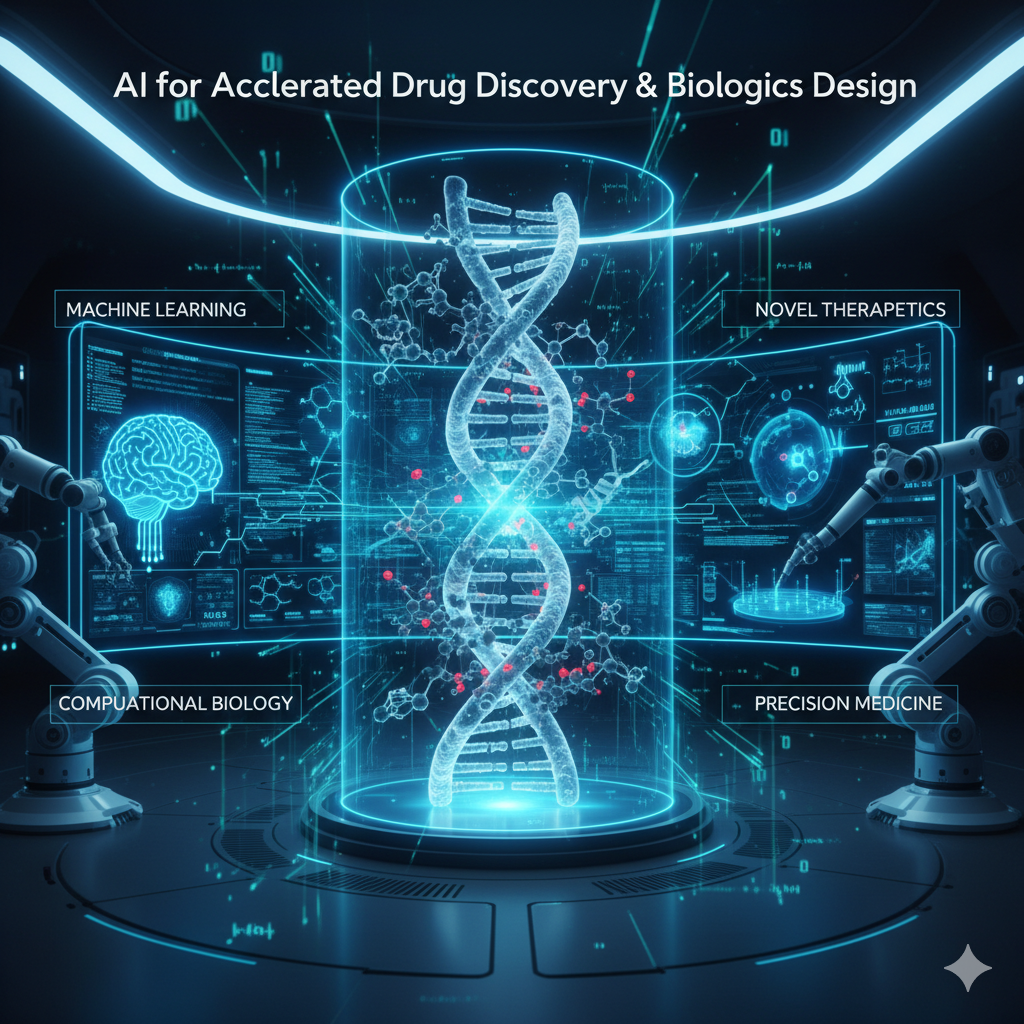
Finding a new medicine used to take over a decade and cost billions of dollars. Today, Artificial Intelligence and Machine Learning are changing that reality. From identifying disease targets to designing complex biological molecules, AI is helping scientists work faster, smarter, and more accurately than ever before.
What Is AI-Driven Drug Discovery?
Traditional drug discovery is slow and expensive. Scientists needed 10 to 15 years and billions of dollars to bring a single drug to market. Many candidates failed in late-stage trials, wasting enormous resources.
AI and Machine Learning change this by allowing researchers to analyse massive datasets, simulate experiments, and predict outcomes in a fraction of the time. What once took years can now take months. This applies not just to chemical drugs but also to biologics — medicines made from living organisms, including proteins, antibodies, and vaccines.
Step-by-Step: How AI Works in Drug Discovery
AI acts like a highly capable research assistant that processes millions of data points and spots patterns humans might miss. Here is how it fits into the drug development pipeline:
- Finding the Disease Target: AI scans scientific literature and biological data to identify genes or proteins linked to a specific disease.
- Designing New Molecules: Generative AI tools create new chemical structures that could work as effective medicines.
- Virtual Testing: Instead of testing thousands of compounds in a physical lab, AI runs virtual experiments to shortlist the most promising candidates.
- Refining the Drug: AI helps optimise molecules to make them safer, more effective, and longer lasting inside the body.
- Planning Clinical Trials: AI analyses patient data to identify the best trial candidates and predict potential side effects before trials begin.
How AI Is Transforming Biologics Design
Biologics are among the most complex medicines available. They are created using living cells and include treatments like monoclonal antibodies, vaccines, and gene therapies. Designing them requires understanding how biological molecules fold, interact, and behave inside the human body.
AI is making this process far more precise. Key contributions include:
- Predicting protein folding and structural behaviour — a capability made famous by DeepMind’s AlphaFold model.
- Designing synthetic antibodies that target specific diseases with high accuracy.
- Modelling how biological molecules react inside the body before any lab work begins.
- Discovering new proteins and enzymes that could form the basis of future treatments.
A real-world example: In 2025, biotech company Nabla Bio partnered with Takeda Pharmaceuticals to use AI for designing new antibody-based drugs, cutting development time from years down to months.
Key Benefits of AI in Drug Discovery
| Benefit | What It Means |
|---|---|
| Faster Results | Reduces research timelines from years to months. |
| Lower Costs | Fewer failed lab experiments means significant cost savings. |
| Higher Accuracy | Identifies the right drug targets with greater precision. |
| Personalised Medicine | Enables treatments tailored to individual patient biology. |
| New Discoveries | Opens doors to treatments for previously untreatable diseases. |
Challenges That Still Need to Be Solved
Despite its promise, AI in drug discovery is not without hurdles. Scientists and regulators are still working through several important issues:
- Data Quality: AI models need large volumes of high-quality, well-structured data to perform reliably.
- Regulatory Approval: Drugs developed with AI assistance must still pass rigorous clinical trials and regulatory reviews before reaching patients.
- Ethics and Privacy: Using patient data to train AI models raises serious concerns about data security and consent.
- Transparency: Many AI systems operate as black boxes, making it difficult for scientists to understand or explain how a particular conclusion was reached.
What the Future Looks Like: 2025 to 2030
The next five years are expected to bring even bigger changes to pharmaceutical research through AI. Some of the most anticipated developments include:
- AI combined with Quantum Computing: Running complex molecular simulations in seconds rather than hours.
- Digital Twins: Creating virtual human models to test how a drug will behave before any human trials take place.
- Personalised Drug Treatments: Medicines designed specifically around an individual’s genetic and biological profile.
- Stronger Industry Collaboration: More partnerships between pharmaceutical companies and technology firms to accelerate the path from discovery to cure.
AI will not replace scientists. Instead, it will give them powerful tools to find new medicines faster, reduce costs, and ultimately make better healthcare accessible to more people around the world.
Frequently Asked Questions
AI analyses millions of data points to identify disease targets, design new molecules, run virtual experiments, and predict clinical trial outcomes — all much faster than traditional lab-based methods. This can reduce drug development timelines from over a decade to just a few months.
Biologics are medicines made from living cells, such as antibodies and vaccines. AI helps by predicting how proteins fold and behave, designing synthetic antibodies, and modelling how biological molecules interact inside the human body — making the design process faster and more accurate.
Key challenges include the need for large volumes of high-quality data, strict regulatory requirements for AI-developed drugs, patient data privacy concerns, and the difficulty of understanding how some AI models reach their conclusions.