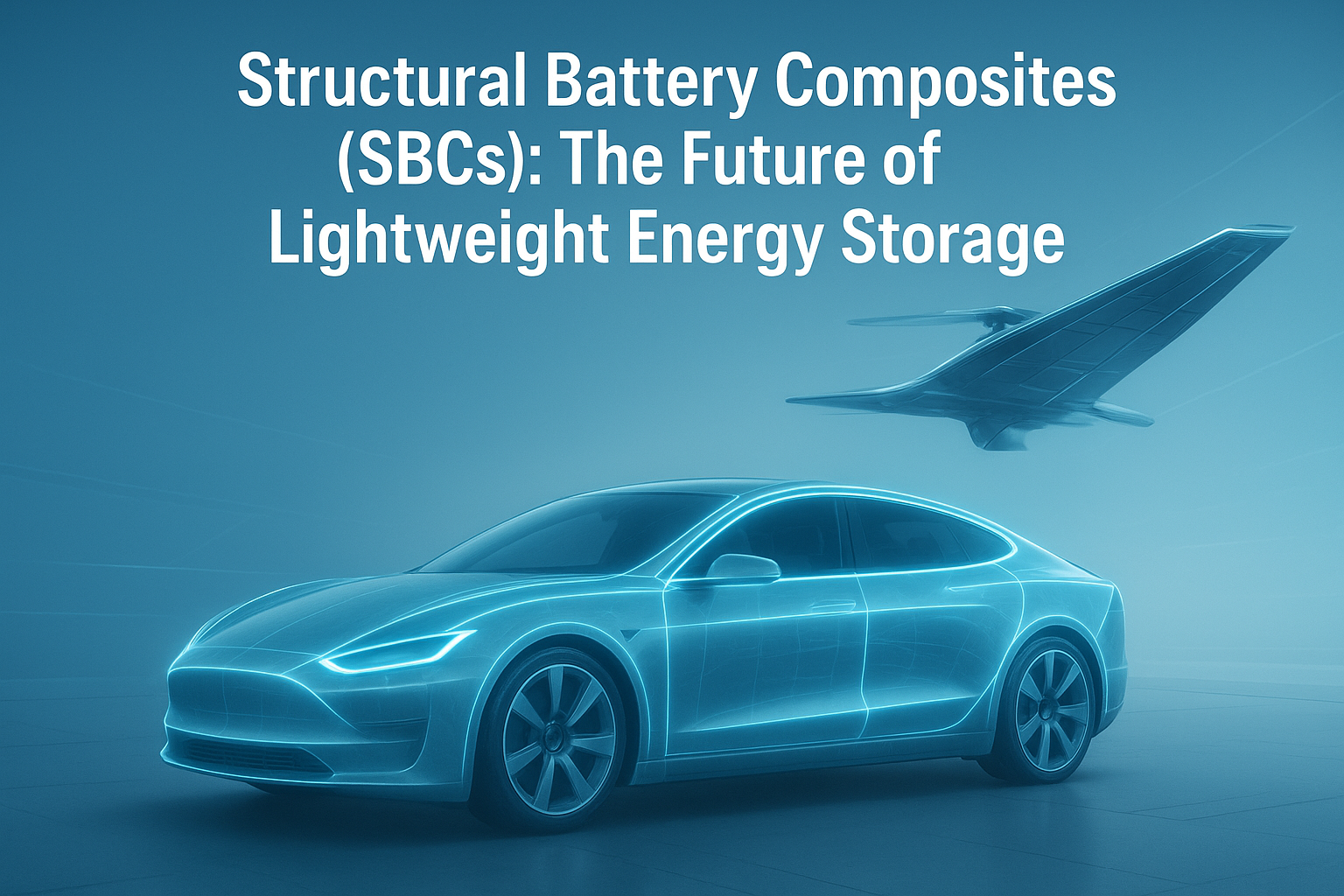
What if the body of your car could store electricity? Or the wings of a plane could act as a battery? That is exactly what Structural Battery Composites (SBCs) aim to achieve. Listed among the World Economic Forum’s Top 10 Emerging Technologies of 2025, SBCs are drawing serious attention from engineers, automakers, aerospace companies, and consumer electronics brands worldwide.
Why Traditional Batteries Are Holding Us Back
Batteries power almost everything we use today — electric vehicles (EVs), drones, laptops, smartwatches, and more. But conventional battery packs come with a major drawback: they are heavy, bulky, and take up a lot of space inside a product.
- Electric cars carry battery packs weighing hundreds of kilograms, making them heavier and more expensive.
- Aircraft cannot load too many batteries without losing fuel efficiency and flight range.
- Smartphones and laptops are constrained in design because the battery occupies most of the internal space.
Engineers have long searched for a smarter solution — one that stores energy without adding extra weight or volume. Structural Battery Composites offer exactly that.
What Are Structural Battery Composites?
Structural Battery Composites are advanced materials that perform two functions at the same time. They store electrical energy like a battery and provide mechanical strength similar to carbon fiber or steel.
In simple terms, the structure itself becomes the battery. There is no need for a separate battery pack. Here are some real-world examples of what this could look like:
- A car’s roof or door panels storing and supplying electricity.
- An airplane’s wing functioning as an energy storage unit.
- A smartphone’s outer casing powering the device from within.
This approach reduces weight, improves structural integrity, and makes products more efficient overall.
How Do Structural Battery Composites Work?
SBCs are built using a combination of specially chosen materials that each serve a dual role:
- Carbon Fibers: These act as the structural backbone of the material, offering strength comparable to steel. At the same time, they function as battery electrodes, storing and releasing electrical energy.
- Polymer Electrolyte: This layer allows ions to move between electrodes, similar to how lithium-ion batteries operate. It also acts as a binding agent that holds the composite layers together.
- Composite Layers: These layers are engineered to bear physical loads and stress while simultaneously enabling energy storage within the same structure.
The result is a material that can support weight like a structural frame and store electricity like a battery — both at the same time.
Key Applications Across Industries
SBCs have the potential to reshape multiple sectors. Here is a look at where they could make the biggest impact:
| Industry | Current Problem | SBC Solution |
|---|---|---|
| Electric Vehicles | Heavy battery packs increase weight and cost | Body panels and roof store energy, reducing pack size |
| Aerospace and Drones | Extra batteries reduce flight range and efficiency | Wings and fuselage double as energy storage |
| Consumer Electronics | Bulky batteries limit slim device designs | Device casing itself holds and supplies power |
| Space and Defense | Every extra kilogram raises launch and operational costs | Lightweight multi-purpose materials cut costs and weight |
Military drones, satellites, and rockets stand to benefit significantly from materials that combine durability with built-in power storage.
Challenges That Still Need to Be Solved
Despite their enormous promise, SBCs are still in active development. Researchers are working through several key challenges:
- Lower energy density: Current SBCs do not store as much power per unit as conventional lithium-ion batteries.
- High production costs: The raw materials and manufacturing processes involved are expensive at this stage.
- Long-term durability testing: Scientists are still running tests to confirm that SBCs can match or exceed the lifespan of existing structural materials under real-world conditions.
These are not insurmountable problems. Research teams across universities and technology companies are actively working to improve energy density, reduce costs, and validate durability through rigorous testing.
Why SBCs Matter for the Future
The broader impact of Structural Battery Composites goes well beyond just saving weight. Here is why they matter on a larger scale:
- Greater efficiency: Lighter vehicles and aircraft consume less energy and travel farther on a single charge or tank of fuel.
- Design freedom: Engineers and product designers no longer need to build products around a large battery. This opens up entirely new possibilities in form and function.
- Environmental benefits: Using fewer raw materials and eliminating large battery packs reduces the environmental footprint of manufacturing and disposal.
- Cross-industry transformation: From EVs and aerospace to wearables and defense, SBCs have applications across nearly every technology-driven sector.
The World Economic Forum’s recognition of SBCs as a top emerging technology for 2025 signals that the scientific and industrial communities are taking this seriously. Experts believe SBCs could begin reshaping EVs, aerospace, and consumer electronics within the next decade.
In the years ahead, cars may not just carry batteries — they may become batteries. Planes could fly farther with wings that store power. Phones and gadgets could grow thinner, tougher, and last longer. Structural Battery Composites represent a meaningful step toward a future where our technology is lighter, stronger, and far more efficient than what we have today.
Frequently Asked Questions
Structural Battery Composites are advanced materials that serve two purposes at once — they store electrical energy like a battery and provide mechanical strength similar to carbon fiber or steel. This means the structure of a product, such as a car body or airplane wing, can itself act as a battery.
SBCs have potential applications in electric vehicles, aerospace, drones, consumer electronics like smartphones and laptops, as well as space and defense equipment. In each case, they reduce weight by eliminating the need for separate, bulky battery packs.
The three main challenges are lower energy density compared to conventional lithium-ion batteries, high production and material costs, and the need for more long-term durability testing. Researchers are actively working to address all three issues.